Leakage Repump
Leakage repump is an active optical pumping protocol to suppress population leakage outside the encoded qubit subspace. System Model H2 provides users with the ability to enable automatic leakage repump during job execution via System Model H2 API options. Narrow‑linewidth optical pumping selectively drives leaked hyperfine states through an auxiliary transition, irreversibly transferring population back into the qubit manifold. For each cooling operation (per 2-qubit gate), an auxiliary laser is applied to the Ytterbium qubit.
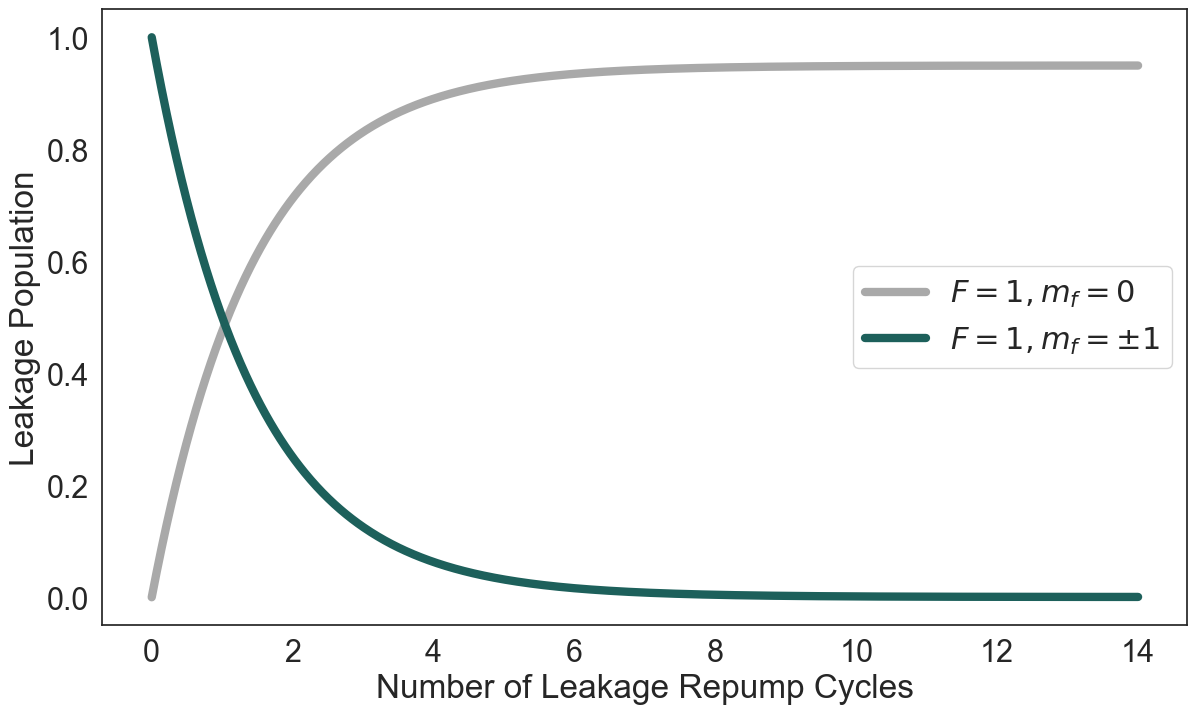
Each repump cycle returns a leaked qubit to the qubit subspace with probability approximately \(1/3\), leaving approximately \(2/3\) of the leaked population after one cycle and \((2/3)^N\) residual leakage after \(N\) repeated cycles. Quantum Error Correction (QEC) protocols cannot correct leakage errors. This repump capability is a protocol to convert the leakage error into Pauli error for further correction with QEC. If a leakage event occurs during a two-qubit gate in the syndrome extraction, one qubit will leak and the other will partially depolarize. Avoiding a subsequent error when the leaked qubit interacts with another data qubit requires the leakage population to be suppressed back below the threshold error level. However, leaked qubits are transitioned to the \(^{2}D_{3/2}\) manifold and then to a \(^{3}[3/2]_{1/2}\) state, before decaying back into the \(^{2}S_{1/2}\) manifold. Each repump cycle is ~1ms and performed during pre-2Q cooling.
Leakage repump can be enabled as a boolean API option, leakage_repump_enable, and passed to QuantinuumConfig as part of backend configuration for System Model H2.
from quantinuum_schemas.models.backend_config import QuantinuumCompilerOptions
import qnexus as qnx

qntm_config = qnx.QuantinuumConfig(
    device_name="H2-Emulator",
    compiler_options=QuantinuumCompilerOptions(
        leakage_repump_enable=True
    )
)
Repump Scheme
The repump scheme is applied to \(^{171} \textrm{Yb}^{+}\) which defines the qubit subspace in the \(^{2}\textrm{S}_{1/2}\) manifold, \(\left\{ | F = 0, m_{f} = 0 \rangle,| F = 1, m_{f} = 0 \rangle \right\} = \left\{ | 0 \rangle, | 1 \rangle \right\}\). The qubit can be controlled via Raman transitions through the excited \(^{2}P_{1/2}\) and \(^{2}P_{3/2}\) states, which includes spontaneous leakage-inducing scattering. Typically, the leakage-inducing events drive qubit population into the \(F=1\) leaked states, \(|F=1, m_{f}=\pm1 \rangle\).
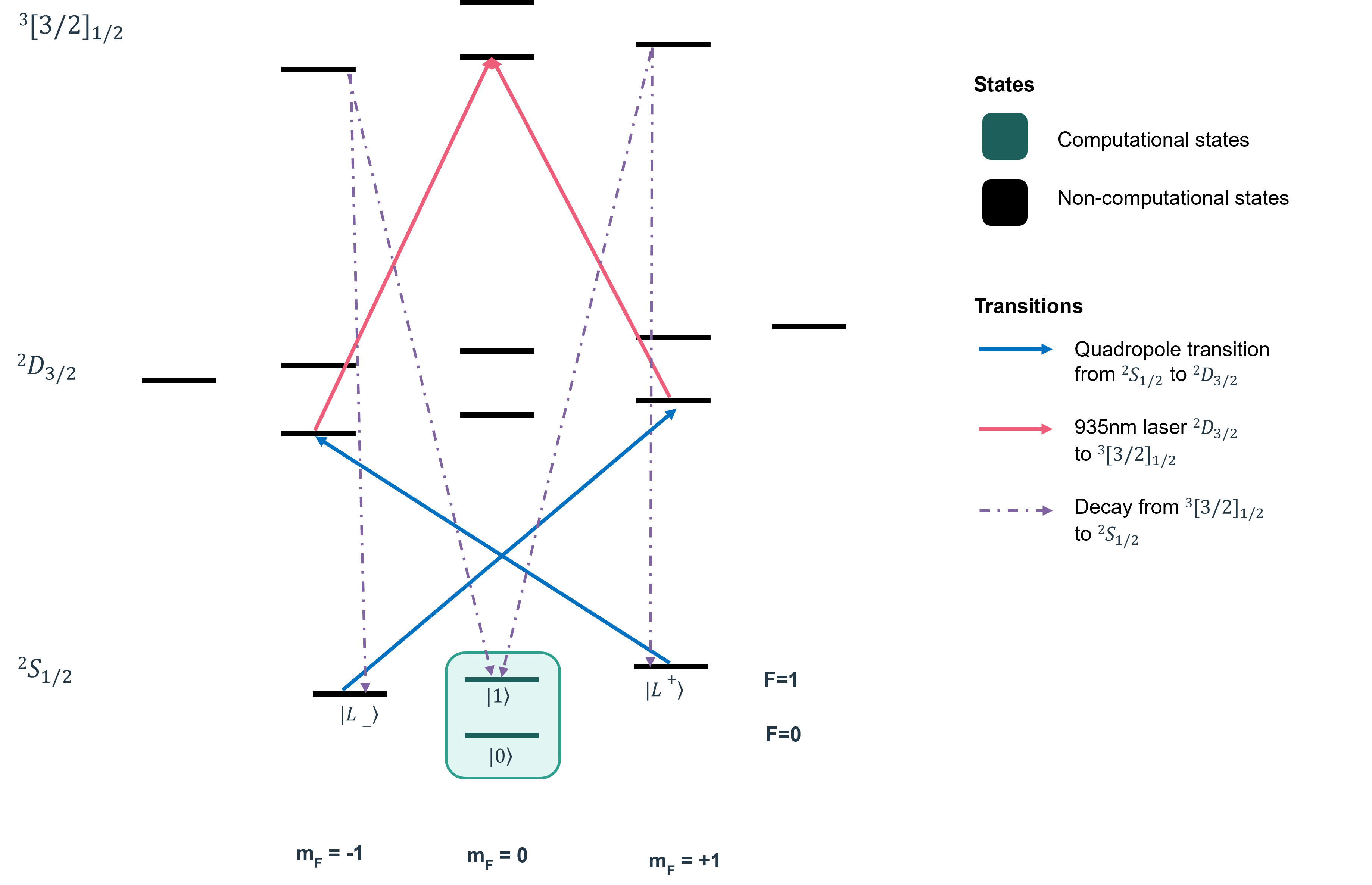
A quadropole transition with a narrow linewidth laser (435nm) relies on spectroscopic resolution to drive only leaked state to the \(^{2}D_{3/2}\) manifold. The qubit subspace is invariant to the quadropole transition. The optical repump scheme is only operational for \(| F = 1, m_f = \pm 1 \rangle\). The transition \(^{2}S_{1/2} \rightarrow ^{2}D_{3/2}\), also does not preserve the azimuthal component of angular moment, \(m_f\), leading to the restriction, \(\Delta m_f = \pm 2\). A 935nm laser drives the population to a braket state, \(^{3}[3/2]_{1/2}, F' = 0, m_f^{'} = 0\), which has a lifetime of 38ns. The transition laser for \(^{2}D_{3/2} \rightarrow ^{3}[3/2]_{1/2}\) induces \(\Delta m_f = \pm 1\). The population decays to the \(^{2}S_{1/2},F = 1\) with \(1/3\) probability of falling into the qubit subspace.
After \(n\) leakage repump cycles, the leakage population is at worst-case suppressed by factor \((2/3)^n\). The population in the qubit space is asymmetric, due to polarization impurities in the 935nm transition. The \(|0 \rangle\) \((\left( |1 \rangle \right)\) pumping rate is 0.50 (0.45). There is also transient population transfer from \(| F = 1, m_f = +1 \rangle\) to \(| F = 1, m_f = -1 \rangle\). The figure below shows the qubit populations, \(P_{\psi}\) across the qubit subspace and the leaked levels.