Trotterized Hamiltonian simulation
Trotterization approximates Hamiltonian time evolution by applying exponentials of simpler terms:
\( H=\sum_{j=1}^{m}h_j, \qquad U(t)=e^{-iHt}. \)
Zixy Hamiltonians
Zixy stores a Hamiltonian as a sum of coefficient-weighted Pauli strings:
\( H=\sum_{j=1}^{m}a_jP_j, \qquad P_j\in\{I,X,Y,Z\}^{\otimes n}. \)
import zixy.qubit.pauli as zqp

pauli_string = zqp.String.from_str("Z0 X1", 2)
hamiltonian = zqp.RealTermSum.from_str(
    "(-0.5, Z0 X1), (-0.1, X0 Z1), (-0.2, Y0 Y1)"
)
zqp.Stringrepresents one tensor product of Pauli operators.zqp.RealTermSumrepresents a Hermitian Pauli Hamiltonian by pairing those strings with real coefficients.trotter_first_orderconverts every non-identity term into a Pauli exponential.
Pauli exponentials
pauli_exp constructs a Guppy function implementing
a Pauli-string exponential:
\( U_P(\theta)=e^{-i\theta P/2}. \)
from guppyalgos.primitives.pauli.pauli_exp import cntrl_pauli_exp, pauli_exp

pauli_gadget = pauli_exp(pauli_string, n_qubits=2)
controlled_pauli_gadget = cntrl_pauli_exp(pauli_string, n_qubits=2)
The input may contain any tensor product of \(I\), \(X\), \(Y\), and \(Z\). Only its non-identity support participates in the parity ladder:
Pauli |
Basis change before the parity ladder |
|---|---|
\(I\) |
None; this qubit is omitted from the ladder. |
\(X\) |
\(H\) maps \(X\) to \(Z\). |
\(Y\) |
Apply \(S^\dagger\), then \(H\), to map \(Y\) to \(Z\). |
\(Z\) |
None; it is already in the required basis. |
For \(P = Z_0X_1\), the ordinary gadget is:

The controlled form uses the same basis changes and parity ladder, but the external qubit controls the central rotation:
\( C(U_P)=|0\rangle\!\langle 0|\otimes I +|1\rangle\!\langle 1|\otimes U_P(\theta). \)
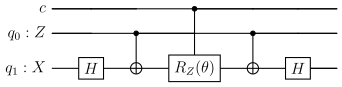
Basis changes map every non-identity Pauli to the Z basis.
A CX ladder computes the joint parity onto its target qubit.
pauli_expappliesR_Zto the parity target.cntrl_pauli_expreplaces it withCR_Z, leaving the target operation inactive when the external control is zero.The CX ladder and basis changes are then uncomputed.
The uncontrolled factory rejects an identity string. The controlled factory preserves its observable relative phase by rotating the control qubit.
Choose the circuit construction
The Pauli string fixes the operator, but it does not fix the circuit used for the parity computation or terminal rotation. These inputs can be selected when the gadget is built:
Input |
Default |
Other supported use |
|---|---|---|
|
Required |
Any \(I/X/Y/Z\) tensor product; |
|
Required integer |
May be larger than the Pauli support, provided every Pauli index is in range. |
|
|
|
|
|
Any compatible |
|
|
For |
For example, this keeps the same \(e^{-i\theta P/2}\) operation while choosing a linear CX ladder and a repeat-until-success rotation:
from guppyalgos.primitives.rotations import (
    dummy_theta_resource_state, repeat_until_success_rz,
)
from guppyalgos.primitives.subroutines.ladders import CXLadderLinear

rus_rz = repeat_until_success_rz(dummy_theta_resource_state)
rus_pauli_gadget = pauli_exp(
    pauli_string,
    n_qubits=2,
    cx_ladder=CXLadderLinear,
    rz_method=rus_rz,
)
The RUS implementation changes how the central \(R_Z\) is synthesized. The basis changes, parity ladder, angle convention, and resulting Pauli exponential remain the same.
See the Pauli-exponential notebook for a complete executable example and alternative rotation implementations.
Constructing the Trotter simulation
A first-order Trotter simulation applies the Zixy term exponentials sequentially, then repeats the resulting step:
\( e^{-iHt} \approx \left(\prod_{j=1}^{m}e^{-ih_jt/r}\right)^r, \qquad \text{error}=O\!\left(\frac{t^2}{r}\right). \)
from guppyalgos.algorithms.time_evolution.trotter import ham_sim_trotter, trotter_first_order

n_state_qubits = len(hamiltonian.qubits)
trotter_step = trotter_first_order(hamiltonian, n_state_qubits)
simulation = ham_sim_trotter(
    trotter_step, n_steps=10, time_step=0.01,
    n_state_qubits=n_state_qubits,
)
The Hamiltonian and product-formula order determine the sequence of Pauli exponentials. The ladder and rotation inputs are passed to every term, so one choice changes the complete Trotter step consistently.
Builder |
Input Hamiltonian or schedule |
Result |
|---|---|---|
|
|
One forward pass through the non-identity terms. |
|
|
Controlled forward pass; retains identity terms as relative phases. |
|
|
Symmetric Suzuki formula; higher orders recursively reduce product-formula error. |
|
Same inputs plus controlled rotation methods |
Controlled symmetric Suzuki formula. |
|
Terms and |
Custom ordering, repeated terms, and signed time factors. |
For example, a second-order step applies half steps forward and backward,
and is built with:
from guppyalgos.algorithms.time_evolution.trotter import trotter_higher_order

second_order_step = trotter_higher_order(
    hamiltonian,
    n_state_qubits,
    order=2,
    cx_ladder=CXLadderLinear,
)
At runtime, each term receives an angle equal to its coefficient multiplied by
the sequence factor and time_step. Negative sequence factors implement
backward evolution. ham_sim_trotter then repeats the completed step
n_steps times.
See the Trotter Hamiltonian-simulation notebook for the complete construction, execution, and accuracy comparison.
Continue with Phase estimation to use controlled Trotter steps in QPE.