Approximate multi-controlled X gate
Download Notebook - cnx_approx.ipynb
Empirical Validation
The \(C^nX\) gate applies an X gate to a target qubit only when all n control qubits are in the \(|1\rangle\) state.
Exact implementations require \(O(n)\) \(T\) gates, whereas the approximate \(C^nX\) gate requires only \(O(log(1/\epsilon))\) \(T\) gates for an implementation within an error \(\epsilon\) .
This algorithm for the approximate multi-controlled X gate originates from the paper arXiv:2510.07223 “Multi-qubit Toffoli with exponentially fewer T gates”.
from math import ceil, log2
from guppylang import guppy
from guppylang.std.builtins import array, comptime, output
from guppylang.std.quantum import qubit, x, measure, discard_array
from guppylang.std.qsystem.random import RNG
from guppylang.std.qsystem.utils import get_current_shot
from guppyalgos.primitives.gate_decompositions.cnx.cnx_approx import cnx_approx
from guppyalgos.utils import qarray
We define the following parameters:
N_CTRL: Number of control qubits
EPSILON: Error bound
SEED: Seed for random number generation
N_SHOTS: Number of simulation runs to estimate error rate
N_CTRL = 10
EPSILON = 0.1
SEED = 1
N_SHOTS = 1000

# Generate the approximate CnX gate with and error EPSILON and N_CTRL control qubits
cnx_approx_fn = cnx_approx(N_CTRL, EPSILON)

# Number of controls for the exact CnX gate
k = min(ceil(log2(1 / EPSILON)) + 2, N_CTRL)

print(f"Number of controls: {N_CTRL}")
print(f"Target epsilon: {EPSILON}")
print(f"Number of shots: {N_SHOTS}")
Number of controls: 10
Target epsilon: 0.1
Number of shots: 1000
To verify the approximate \(C^nX\) gate implementation, we set up a test where some control qubits are initialized in \(\lvert 0 \rangle\). Since not all controls are \(|1\rangle\), the target should remain \(|0\rangle\) after applying \(C^nX\). We expect the error rate to be at most \(\epsilon\).
@guppy
def test_cnx_approx() -> None:
    # Initialize controls
    controls = qarray(N_CTRL)
    for i in range(comptime(N_CTRL - 1)):
        x(controls[i])

    # Initialize target to |0⟩
    target = qubit()

    # Create RNG with shot-dependent seed
    rng = RNG(SEED + get_current_shot())

    # Apply approximate cnx gate
    cnx_approx_fn(controls, target, rng)

    # Measure target
    target_result = measure(target).read()
    output("target_result", target_result)

    # Cleanup
    rng.discard()
    discard_array(controls)
We run the circuit N_SHOTS times to statistically estimate the error rate of the approximation. A shot is successful if the target is measured as \(|0\rangle\).
n_ancillas = (k - 2) // 2 + (k - 2) % 2 if k > 2 else 0
n_qubits = N_CTRL + 1 + n_ancillas

results = test_cnx_approx.emulator(n_qubits=n_qubits).with_shots(N_SHOTS).run()

shots_data = results.collated_shots()
successes = sum(1 for shot in shots_data if not shot["target_result"][0])
success_rate = successes / N_SHOTS
error_rate = 1 - success_rate

print(f"\n=== Results ===")
print(f"Epsilon: {EPSILON}")
print(f"Successes: {successes}/{N_SHOTS}")
print(f"Success rate: {success_rate:.4f}")
print(f"Error rate: {error_rate:.4f}")
=== Results ===
Epsilon: 0.1
Successes: 994/1000
Success rate: 0.9940
Error rate: 0.0060
Resource Estimation
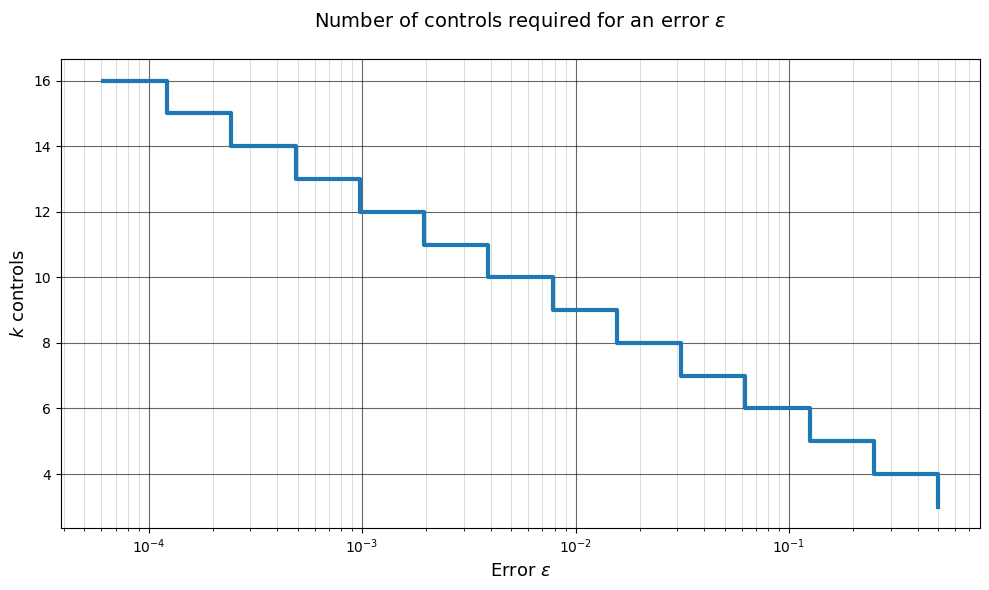
The algorithm guarantees that the approximate \(C^nX\) is implemented to within error \(\varepsilon\) in the diamond distance. To do this approximation, the algorithm requires an exact \(C^kX\) gate where \(k\) is given by: $\(k = \lceil \log_2(1/\varepsilon) \rceil + 2.\)$
The key advantage is that \(k\) grows logarithmically with \(1/\varepsilon\) and is independent of \(n\), the number of controls in the \(C^nX\) gate. This means the \(T\)-count is \(O(\log(1/\varepsilon))\) instead of \(O(n)\).
The graph below shows the \(k\) value with respect to \(\varepsilon\). For example, for \(\varepsilon = 0.01\), we get \(k = 9\). This means that a \(C^nX\) gate (\(n\) controls) can be approximated with the same number of \(T\) gates as implementing an exact \(C^{9}X\) gate (9 controls).
import matplotlib.pyplot as plt
import numpy as np

epsilon_values = np.array(sorted([2**(-k) for k in range(1, 15)]))
k_values = np.array([ceil(log2(1 / eps)) + 2 for eps in epsilon_values])

plt.figure(figsize=(10, 6))
plt.step(epsilon_values, k_values, where='post', linewidth=3)
plt.xscale('log')
plt.xlabel('Error $\\varepsilon$', fontsize=13)
plt.ylabel('$k$ controls', fontsize=13)
plt.title('Number of controls required for an error $\\varepsilon$\n', fontsize=14)
plt.grid(True, which='major', alpha=0.6, linewidth=0.8, color="black")
plt.grid(True, which='minor', alpha=0.2, linewidth=0.5, color="black")
plt.tight_layout()
plt.show()