Alias-sampling state preparation
Download Notebook - alias_prep.ipynb
Alias sampling loads a classical probability distribution into a quantum index register. It prepares the index together with workspace:
The probabilities \(\widetilde p_j\) approximate the requested weights at a chosen binary precision. The index need not be a pure state on its own: the workspace can be entangled with it.
Run from a source checkout with the development dependencies installed. The repository default is little endian.
1. Choose the distribution and precision
Use \(p=(1/2,1/4,1/4)\). Two index qubits address the three entries, leaving address 3 unused. Two probability bits represent these weights exactly:
discretize_distribution gives the probabilities the finite-precision circuit will load. Smaller precision values use more probability bits.
prob_dist = np.array([0.5, 0.25, 0.25])
precision = 0.25
n_index_qubits = ceil(log2(len(prob_dist)))
n_prob_bits = ceil(log2(1 / precision))
loaded_probabilities = discretize_distribution(prob_dist, n_prob_bits)
np.testing.assert_allclose(loaded_probabilities, prob_dist)
2. Build and run PREPARE
The alias QROM loads an alternative index and a keep threshold. A uniform comparison register chooses whether to keep the original index or swap in the alternative.
Register |
Purpose |
|---|---|
|
The sampled table index. |
|
The alternative index loaded by QROM. |
|
The fixed-point keep threshold. |
|
The uniform value compared with that threshold. |
|
The comparison flag controlling the swap. |
All registers start at zero. fanout_op chooses how QROM writes the selected data bits; here it uses basic CNOT fanout.
alias_prepare = alias_samp_prep(prob_dist, precision, fanout_op=fanout_basic)


@guppy
def main() -> None:
    index_qreg = qarray(n_index_qubits)
    alternative_qreg = qarray(n_index_qubits)
    keep_qreg = qarray(n_prob_bits)
    comparison_qreg = qarray(n_prob_bits)
    comparison_result = qubit()
    alias_prepare(
        index_qreg, alternative_qreg, keep_qreg,
        comparison_qreg, comparison_result, False,
    )
    state_output("result_state", index_qreg)

    # This diagnostic is finished; no coherent operation follows.
    discard_array(index_qreg)
    discard_array(alternative_qreg)
    discard_array(keep_qreg)
    discard_array(comparison_qreg)
    discard(comparison_result)


total_qubits = (
    3 * n_index_qubits + 2 * n_prob_bits + 5
    + int(np.ceil((n_index_qubits - 3) / 2))
)
result = main.emulator(total_qubits).with_seed(42).run()
3. Check the index probabilities
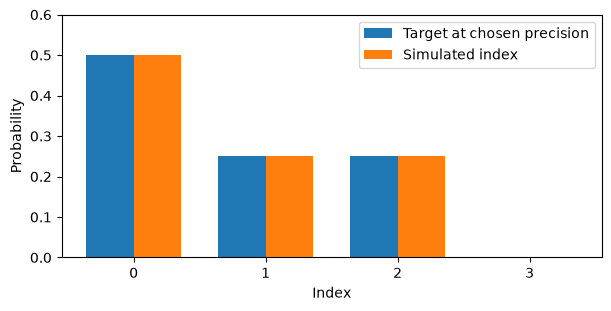
Trace out the workspace before comparing with the requested distribution:
The simulator represents the reduced index state as a weighted mixture. Sum each component’s squared magnitude, weighted by its probability; squaring complex amplitudes directly would be incorrect.
mixture = result.partial_state_dicts()[0]["result_state"].state_distribution()
observed = sum(component.probability * np.abs(component.state)**2 for component in mixture)
expected = np.zeros(2**n_index_qubits)
expected[:len(prob_dist)] = loaded_probabilities
np.testing.assert_allclose(observed, expected, atol=1e-10)

indices = np.arange(len(expected))
fig, axis = plt.subplots(figsize=(6, 3), layout="constrained")
axis.bar(indices - 0.18, expected, width=0.36, label="Target at chosen precision")
axis.bar(indices + 0.18, observed, width=0.36, label="Simulated index")
axis.set(xlabel="Index", ylabel="Probability", xticks=indices, ylim=(0, 0.6))
axis.legend()
plt.show()
Use alias preparation inside an algorithm
Pass True as the final argument to apply UNPREPARE, using the same registers. PREPARE followed immediately by UNPREPARE restores the initial state.
After an intervening SELECT, the workspace need not return to zero. Retain it for subsequent coherent operations and include it in any preparation-state reflection. The block-encoding demo shows the complete PREPARE → SELECT → UNPREPARE composition and how to change the alias-QROM fanout.